

The Institute for Government has said that one reason why Governments commission “Independent Reviews” is that they show that they are acting when they are not entirely sure what they want to do. Reviews are presented as bringing in a fresh pair of eyes, or specific expertise, free from any Party or Departmental predispositions – and also free of an expectation that they will bind the Government by what they say. Not all Reviews result in subsequent action.
Sometimes, however, they may also been seen as a way of building momentum for policy positions and of setting expectations. Make the right pick of expert and you get a Review that guides policy in a direction you may have been cautious about proposing without this sort of advance framing.
The Sir Charlie Mayfield review into ““tackling health related inactivity and creating and maintaining healthy and inclusive workplaces” was perhaps one example of this. And Alan Milburn’s “Young people and work: interim report” has the appearance of being another. It certainly opens a door to the possibility that controversy around key social policies – involving the minimum wage and welfare benefits and health concerns – will be intensified.
The central findings of the Report are that 1 in 8 people between in ages of 16 to 24 are not in education, employment or training (NEET), that this has become a “structural feature” (with the NEET rate barely registering below 10% in the last 25 years), and that one noticeable change is that more people now attribute their NEET position to health issues: “over the past decade, the proportion who say they are NEET due to a work-limiting health condition has increased by 70%. The proportion of disabled NEETs citing mental health as their primary condition has almost doubled to more than four in ten”.
Milburn argues that this situation is problematic for a wide range of reasons. He argues that it creates social detriments, such as disengagement and the idea that being out of work leads to a sort of personal under-development.
But he also points to more specific harms for the individuals directly affected, expressed as a life-long consequential loss of earnings and status.
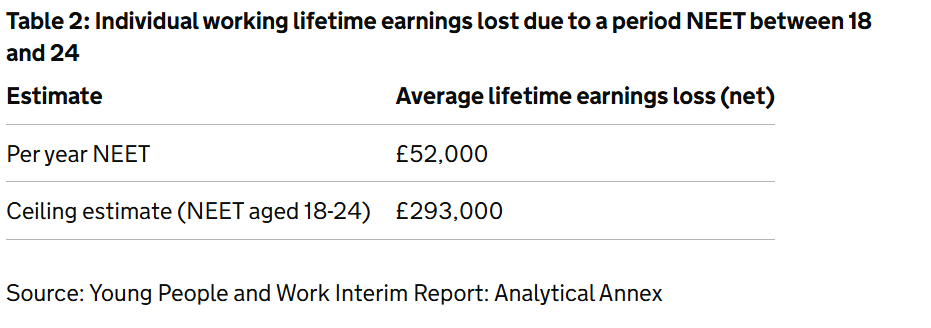
The Report says: “For individuals already at the greatest disadvantage, the intersection of financial challenges with family, personal and health circumstances can deteriorate outcomes even further. Centrepoint estimates over 120,000 young people were homeless or at risk of homelessness in the UK in 2025, a 6% increase on the previous year.[footnote 597] Although some young people experiencing homelessness will be employed or in education, the instability of worklessness is a significant risk”.
Significantly, there is also growing failure of academic achievement to provide any economic pay-back: “of the NEET population, nearly 30% are now getting good GCSEs or equivalent, over 21% have a Level 3 qualification and 15% have a degree”.
Parts of the Report’s analysis display clear links to the attitude already shown by the Government in its “Pathways to Work” Green Paper and more recent “Broken Fit-Note” initiative.
The “benefits system” is asked to do a lot of the heavy lifting, the point of view promoted being perhaps best summed up by this passage: “The state must continue to provide a financial safety net and help people, particularly those with disabilities, who may have extra costs or never be able to work. But for young people, that cannot be where the role of the welfare system ends. It must also give those who can participate a real chance to do so”.
An approach perhaps first given teeth in the context of the Major Government’s introduction of Incapacity Benefit and Jobseekers Allowance, continues to assume that there needs to be a disciplinary hue to benefit entitlement, alongside an implied dash of moral indignation and a particular interpretation of claimants’ psychology.
“They” says Milburn “are being categorised as unfit to work not least through the fit note process, when with help, support and earlier intervention, they would be able to do so”. And: “The benefits system is founded on a deficit model of disability, one that pays for what a young person cannot do rather than investing in what they could become”.
“A disabled person who seeks support is offered a benefit assessment, not a conversation about their goals, their struggles, the support around them and the help they need. The system measures functioning. It does not plan for improving it. It asks what a young person cannot do. It does not ask what they could do, with the right support, or what they want to do. It measures what someone cannot do and writes a cheque”.
There are problems with this.
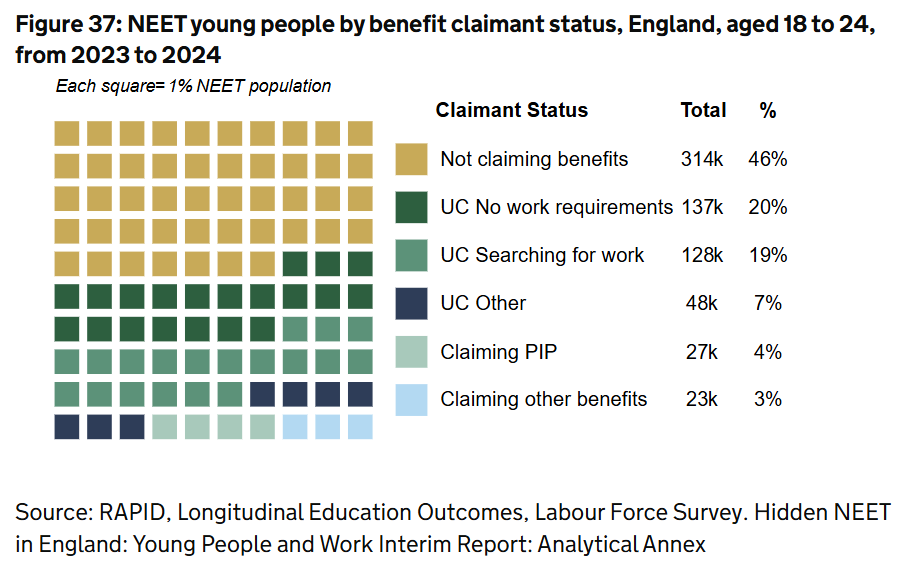
First of all, a substantial proportion of “NEETs” are not even engaged with the “benefits system”. The Report itself says: “according to the Resolution Foundation, around 44% of NEET young people in the UK are not claiming out of work benefits”, and it provides a Table to back this up:
Secondly, Milburn seems to be labouring under a false impression of how a system, already shot through with “conditionality, actually works. In most cases, it does not simply “write a cheque”.
A person now claiming Universal Credit on grounds of incapacity (which covers both health and disability) faces a Work Capability Assessment (WCA). They are then given a decision afterwards that says if they:
• are fit for work (also known as ‘capable for work’),
• have limited capability for work (LCW), but need to prepare to work in the future, or
• have limited capability for work and also for any work-related activity (LCWRA).
This mirrors the long-standing ESA practice of dividing claimants between the “Work Related Activity” group and the “Support” group. If they are in the second category they can already be required to engage with conversations and activities focuses on their capacities and goals.
Alongside this, there is nothing in the design of the system – though there may be resource constraints – to prevent people in the “Support” or “LCWRA” groups from seeking Work Coach support. We understand that all Jobcentres, for instance, are still supposed to have a Disability Employment Advisor.
Arguably, the problem with the system is not that there is not enough conditionality, but too much. In September 2024 the “Commission on the Future of Employment Support” commented that: “The last 20 years have seen a relentless ratcheting up of labour market requirements for people claiming benefits, alongside ever tougher penalties and stricter application of the rules. This has often happened with very little or no evidence to justify it, and there is growing evidence that these changes have made things worse rather than better – pushing many people away from support, especially those with health and caring needs; and leading to a range of unintended negative impacts on individuals and families affected (including often poorer employment outcomes)”. They did not go the whole hog of recommending abandonment of sanctions, but others have highlighted their potentially malign impact. The 2025 Report by report by the Public Law Project (PLP) and Central England Law Centre (CELC), “Sanctionable Failures: Universal Credit’s failing sanctions regime and the harm it causes”, for instance, found that “the current Universal Credit sanctions system fails on its own term, is disproportionately severe and does not prevent inappropriate sanctions”. “Research participants reported sanctions leading to the need to use food banks, incur debt, negative impacts on physical and mental health and reduce their ability to search and undertake work”.
DWP Secretary Pat McFadden has picked up on the “writes a cheque” comment: “I don’t believe” he is reported to have said, “government fulfils its responsibilities simply by writing a cheque”. But there is a case that that is what the “benefits system” should be focussed on – with “conditionality” and “work support” kept well away from it. Much of the activity that has built up around “conditionalities” of one sort or another is really a displacement of work that should be taking place either within a healthcare or a separate employment support environment. It is no wonder that the system collapses into futile trench warfare with the poor when claimants see every contact with it as carrying a potential threat to what little income it provides. In health cases, that can be the very thing to encourage someone to concentrate on “proving” their illness.
Milburn notes that “money is spent on providing income support rather than on “employment support”: “Overall, we estimate that in 2024/25 for every £1 that DWP spent on employment support for young people, around £25 was spent on benefits for young people”. But that is only a criticism of the “benefits system” because decisions have been made to entangle employment support with benefit payments – a path that has led only to the flaws associated with JSA “conditionality” and ESA “work capability assessments”. Perhaps rather than merging the National Careers Service with Jobcentres the Government would do better to make it the foundation of a separate “Employment Support Service”, and give it the funds to deliver schemes like Access to Work much better than is currently the case.
Besides, as we have argued in respect of the clearly related attitude towards “broken fit notes”, the key things to focus on with regards especially to the manifestation of growing mental health issues are GP provision, community mental health services, and the underlying social causes.
The Report itself notes the link between ill-health and deprivation: “NHS England’s survey of the mental health of children and young people found stark inequalities. Children aged 8 to 16 with a probable mental disorder were more than 4 times more likely to live in a household unable to afford enough food, and almost 3 times more likely to live in a household unable to afford heating than those without a probable mental disorder”.
It also makes some interesting points about changes in employment sectors. For instance, on the decline in retail jobs – “Retail was for decades the single largest employer of young people. Online shopping has risen from less than 5% of retail sales in 2008 to more than 26% in 2024. There were 8,000 fewer retail outlets on high streets in 2025 than in 2019. Employment in the sector remains below pre-pandemic levels, while vacancies have fallen sharply over the past decade”. No doubt self-service tills and the like have had an impact on top of the growth in online shopping.
And it acknowledges the particular impact of precarious work on young workers: “Platform and gig work has not made up the difference. It can provide income, but it rarely offers training, progression or a durable connection to an employer. When it becomes the only option, it does not provide a firm foundation for a working life”.
Disability also has a big impact. “In 2024/2025, 29.6% of disabled young people were NEET in the UK compared with 8.7% of non-disabled peers, a gap of 20.9 percentage points”.
It is interesting to see that the Report says employers emphasise psychosocial impediments to recruiting and retaining young employees: “In their engagement with the review, employers also pointed to a wider support challenge, employers also pointed to a wider support challenge around anxiety, confidence, reliability and the ability to cope with workplace demands from the first day. Several pointed to weaker interpersonal confidence among some young applicants: speaking to customers, answering the phone, dealing with pressure and operating in unfamiliar environment“. It does not appear to cross-reference this with the evidence from Trade Union H&S reps that psychosocial hazards – stress, excessive work pressures, bad boss behaviour – have become in general increasingly noticeable features of working life.
The connection has recently been identified by the “New Economics Foundation” in their July 2026 Report “
The good work effect: How high-quality work can lead a jobs recovery”, which seeks to address how the nature of work itself – such as more precarious and lower-quality jobs – might be contributing to exits from employment. “We suggest that the ability of workers to be well-supported by their employers during disruptions to their working life – such as an economic shock like Covid, or periods of ill health – is a critical and underexplored part of the story on economic inactivity”.
The Jimmy Reid Foundation, in an article on Young People and Work, has noted that “There has been a predictable, if inaccurate, response from employer organisations. They cite higher national insurance rates, increases in the minimum wage and employment protections. This overlooks the fact that this issue predates any of these policy interventions. The IFS also found no clear evidence that higher minimum wages have been a ‘major driver’ of young people becoming NEETs, and most young adults aged 18–20 are largely exempt from employer National Insurance”.
The “Work Foundation” has noted that “Young people tend to be a bellwether of the economy and one of the first groups to be impacted by a weakening labour market”. The real key to understanding the position of young workers must be that they are particularly vulnerable to the weak and troubled condition of the British economy overall, with its particular ability to allow wealth to pile up whilst poverty and regional inequalities have become engrained. Milburn, when it comes down to it, himself admits: “The geography of where young people are most likely to be NEET maps onto the geography of labour market weakness with an almost perfect symmetry”. In other words it is the health of labour market demand that is playing a fundamental role – both directly, and then in the knock-on sense identified in the form of the impact of deprivation.
The TUC has called for the following commitments in response to the Report:
- Expand the jobs guarantee for young people. Real experience of decent, paid work is the best way to turn the tide on rising rates of worklessness. The Government have made a good start, introducing a jobs guarantee, but it should be bigger, faster and more ambitious
- Drive up the quality of work. Given the evidence that poor quality jobs can drive economic inactivity, the government should ensure full and rapid implementation of the Employment Rights Act and the government’s Make Work Pay agenda, in particular measures that will support job security.
- Ensure young people’s opportunities are a cross-government priority. Government convening and spending power should be used to create opportunities for young people in areas with the highest NEET rates.
- Reform apprenticeships. Reversing the decline in apprenticeships for young people requires improving quality, expanding provision and ensuring apprentices are financially supported to complete their training. The industrial strategy is a golden opportunity to create sustainable, quality apprenticeships.
- Reform funding for education. Both further and higher education are facing a financial crisis. The government should work with unions on a sustainable workforce strategy and ensure colleges and universities have the capacity needed to deliver apprenticeships and wider learning opportunities.
- Reform funding for health. Given the high rates of young disabled people who are NEET, fully funded comprehensive rehabilitative services as part of NHS care is a fundamental step in supporting young disabled workers and individuals with ill health to return to and stay in employment.