We’ve been getting a bit hot under the collar recently about an initiative that it turned out we were going to dodge – at least, in the short term. But it did raise quite a number of issues we remain worried about.
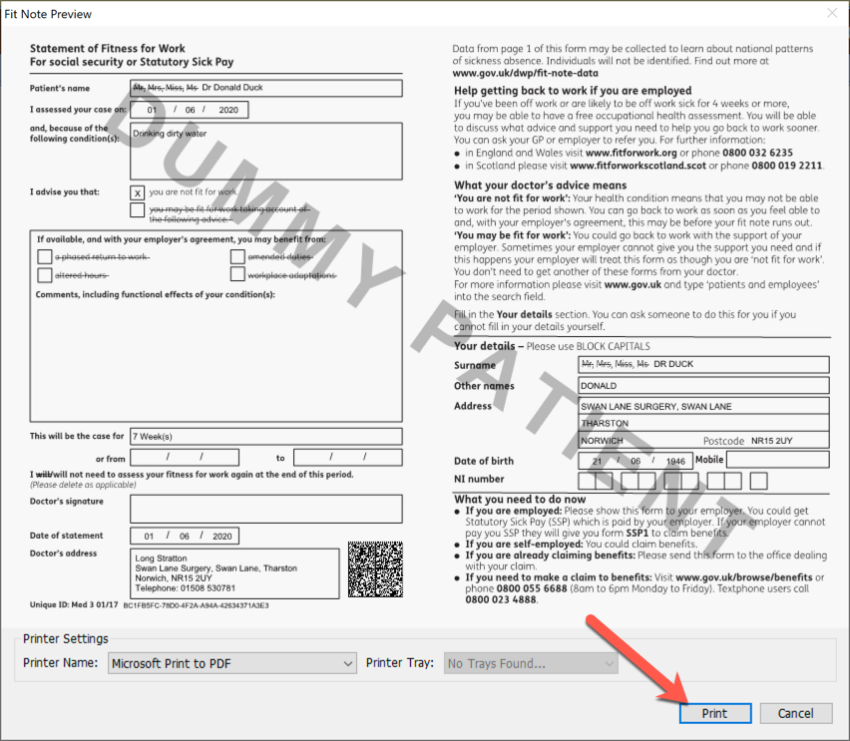
At our June meeting we noted that a Press Release issued jointly by the Department for Work and Pensions and Department of Health and Social Care on 20th May 2026 (and headed “Broken fit note system to be overhauled”) was indicating that workers in Lancashire and South Cumbria were, from this July, to be guinea pigs in a “pilot” scheme where GPs, if presented with a request for a Med3 certificate (or “fit note”), would “refer patients to a support service made up of both clinical and non-clinical staff, without issuing a fit note“ (our emphasis).
Med3 certificates are required by employers for claims of SSP when a period of sickness goes over 7 days, and, in many cases, for claims of occupational sick pay. As workers, we would be quite happy, of course, for employers to simply take us at our word – but in the case of SSP they must follow guidance and in the case of occupational sick pay they are within their rights to require medical evidence.
You can imagine it was a cause of some alarm that there appeared to be no indication of how anyone would be able to get this documentation if their employer wanted it, but their doctor was no longer issuing them. We started sending off letters of complaint left, right and centre.
It then became clear out that “pilot” was to be a lot more modest in geographical scope than the Press Release implied. It will be concentrated on a number of GP practices in Barrow (in Furness), and for practices outside of the pilot area there will be no change to the current Med3 processes.
So – panic over to some degree. But there are issues behind this initiative that remain and which, no doubt, will wash up on our doorsteps in due course.
For one thing, we are not happy about what this “pilot”, and all the talk about “broken fit notes”, tells us about how the government views workers.
A lot is bound up with a “a non-statutory independent review” into the role of UK employers and government in “tackling health related inactivity and creating and maintaining healthy and inclusive workplaces”, that Sir Charlie Mayfield was asked to undertake.
Mayfield was Chairman of the John Lewis Partnership from 2007 to 2020, having joined the Partnership in 2000. In 1996 he had a spell with notorious consultants McKinsey and Co.
His “Keep Britan Working Report”, published in November 2026 read in many ways like the guff normally surrounding an “Attendance Management” policy – you know the score: “more support to stay in work, or return to work”. But he also chipped in with an iteration of the frustration that employers can feel when their staff get “signed off”, and he wrote about “a “Workplace Health Provision” service that would, eventually, take over some of the role of independent medical certification: “Fit notes would remain at least initially, but dependency on them should diminish as Stay-in-Work and Return-to-Work Plans mature. GPs and neighbourhood health services should retain overall clinical responsibility and should remain a referral point where clinical support is required”.
We said at the time that “these ideas are all about undermining the strength of the position of the worker in relation to the employer, and whilst Unions will encourage genuinely therapeutic efforts by employers there remains a need for workers to have solid ground upon which to stand when it comes to their own health and well-being in relation to their work”.
Really there are two things being implied. One is that sickness absence can be down to some sort of character flaw on the worker’s part, and that a little chivvying along can work wonders in getting noses back to the grindstone. The other is that out of work workers on benefits are keen to duck the malign and punitive conditions of “work conditionality” and hence seek shelter on sickness benefits.
Even prior to the Mayfield review, the Government had undertaken a “call for evidence” on fit note reform, which ran from April to July 2024. They had to acknowledge, in summarising the responses to this, that there were big differences between the views of “us” and “them”:
“Patients” they said “generally found the fit note process was working well at supporting their work and health needs. Obtaining fit notes was commonly seen as an accessible, straightforward process. Several patients highlighted that GPs understood the wider context of their illness and were able to make an informed, unbiased decision on their ability to work. Many respondents also felt that the fit note enabled them to have the time and space to properly recover from illness and facilitated access to effective and appropriate treatment and/or support”.
Unfortunately, this was not enough for the government to leave well enough alone.
Whilst Trade Unions will encourage genuinely therapeutic efforts by employers, we have, unfortunately, seen too much persecution, hostility, and disrespect dressed up in the camouflage of concern, both in the benefits system and in “Attendance Management” procedures.
What we face now, moreover, is not just an underlying mistrust of workers, but also a focus on wrong priorities.
Two key issues are the importance of the GP/patient relationship and what excessive numbers of patients per GP can do to this.
We have read what the BMA has to say in their 2024 paper “Patients First”, and we agree with their observation that “Patients want access to a GP. preferably, their GP”. One of the indispensable foundations of the NHS, and of ensuring the right balance between primary and specialist care, is that Practices need GP to patient list size ratios small enough to ensure manageable workloads and patient safety. This is precisely one of the key issues we face in Blackburn with Darwen.
A BBC News report in October 2024 claimed that we have the third highest number of patients for each permanent GP of identified areas in England. In 2024 Nada Khan reported in the “British Journal of General Practice 2024” (“GP workload and patient safety”) on the concerns that GPs across the UK generally were expressing about the adverse impact of increasing patient to GP ratios, and how poorly these compared with comparators:
“The recent Royal College of General Practitioners (RCGP) ‘GP Voice’ survey has highlighted the tension clinicians are feeling between workload, pressures on time, and concerns about patient safety. Overall, 76% of GPs responding to the survey think that patient safety is being compromised by their excessive workloads. This boils down to a matter of time, with 60% of responders reporting that they don’t have enough time to adequately assess and treat their patients during appointments”.
“Patients First” makes an additional point that “According to the Health Foundation, the PCN (primary care networks) DES (Directed Enhanced Service) is worsening health inequalities – but we have an opportunity to achieve the right balance. The decision to invest in associate roles across primary medical care was undertaken in the USA before England. The evidence did not support the hypothesis, and the findings prompted policymakers to move back to a model of a doctor being the primary provider of family medicine”, and “Tellingly, we are now also seeing the lowest proportion of consultations by GPs themselves, also around 44%, due to supervising responsibilities for other additional PCN staff.17 This imbalance has impacted on practices’ ability to offer routine appointments, driven by a relentless focus on ‘access’ whilst ignoring capacity and fracturing continuity”. Reading these comments from doctors cannot but make us concerned that the “pilots” may be a further step along a mistaken direction of travel.
The most plausible reality seems to us to be that there at minimum needs to be some form of Practice level triage. Some cases will be obvious – the goalkeeper with a broken hand. Others may benefit from a degree of ancillary input from a support service with a degree of specialist training in occupational health issues. Even so, deciding the best way forward should remain a matter for the GP and the patient to discuss.
Alongside the underdevelopment of GP provision, the condition of community Mental Health services also needs to be considered. According to Blackburn with Darwen Borough Council (EBD1: Executive Board Decision) local data shows that many young people and adults in Blackburn with Darwen experience poor mental health. The prevalence of depression has been increasing in the borough year-on-year. With the percentage of aged 18+ patients with depression, as recorded on GP disease registers, at 17.2%. (2023) This is significantly higher than the national figure of 13.2%. There are over 2,400 people (all ages) with a diagnosis of severe mental illness (including schizophrenia, bipolar disorder or other psychoses), accounting for 1.34% of the total GP registered population. This is higher than the England prevalence of 1.00%. The “Beyond Imagination Life Survey” published in May 2023 found that “those with a long-term issue that reduced their ability to carry out day-to-day activities showed over a 1-in-2 chance of scoring low WEMWBS (The Warwick-Edinburgh Mental Wellbeing Scale)………and for those out of work due to ill health the chance of a low score was over 3-in-4. This indicates that these groups are at increased risk of conditions associated with poor mental health, such as depression“.
We are not aware of any specific study of local provision, and how well it is coping, but we have no reason to suspect that we are in any way significantly different from the rest of the country. The Care Quality Commission has reported that “people’s experiences of NHS mental health services provided in the community are poor”: Community mental health survey 2023 – Care Quality Commission. Commenting about the impact on A&E departments, the Royal College of Emergency Medicine, in their “Best Practice Guideline – Frequent Attendance in the Emergency Department” noted that: “The number of patients frequently attending EDs as a result of unmet health and care needs, or with underlying vulnerabilities is rising. An ED visit is not always beneficial for these patients and may increase heath care anxiety. Frequent attendance to the ED is often a reflection of a system wide deficiency of care for the most vulnerable members of society and this patient group has often been marginalised in the ED and other healthcare settings”.
The impact on Blackburn with Darwen A&E Services, which might possibly be seen as a proxy indicator for the situation of Mental Health support more widely, has been particularly illuminated by a local Healthwatch Report from September 2024, “Understanding the reasons for mental health attendances at Royal Blackburn Hospital Emergency Department”. Amongst its recommendations, it said there is a need to “increase promotion of mental health services available in primary care and increased awareness amongst primary care staff to reduce GP referrals to Emergency Department”.
One elephant in the room of Sir Charlie Mayfield’s “Keep Britain Working” Report is an apparent lack of curiosity about the extent to which employment itself is a cause of illness. His discussion of the “responsibilities” of employers does not seem to go so far as to encourage them to consider that it may be their own workplace environments playing a significant part in what has become a burgeoning significance of psychosocial harms arising from, and created by, work. Maybe the International Labour Organisation was wasting its breath in making this the key theme of this year’s International Workers Memorial Day.
The psychosocial working environment is defined by how work is designed, organized and managed, and the organizational practices that shape everyday working conditions. Psychosocial factors – such as workload and working time, role clarity, autonomy, support, and fair and transparent processes – strongly influence how work is experienced and affect workers’ health.
As “Hazards” reported in its Spring issue, “Statistics released by the Health and Safety Executive (HSE) in November 2025 show in Great Britain “mental health conditions remain the primary driver of work-related ill health, with 964,000 workers reporting stress, depression or anxiety caused or made worse by work in 2024/25.” HSE says this “is in line with the upward trend in recent years”. This is some understatement. It is the highest figure on record, up 24 per cent on the previous year. This should be no surprise. The findings of TUC’s survey of more than 2,700 union safety reps published in January 2026 revealed “79 per cent of safety reps cite stress as a major hazard – the highest figure recorded and significantly above all other hazards.”
It also says “A 2025 paper in the journal Occupational Health Science emphasises how unions succeed by giving workers ‘agency’ and ‘collective strength’. It notes: “The right to a safe and healthy working environment will not be achieved by simply relying on employers becoming more benevolent or health and safety regulators more diligent. It is only through the respect and promotion of a rights-based approach that illness, injury, and death will ultimately be eliminated from the world of work.” It adds: “Unions are critical in ensuring workers have agency at work and across society. Not only do they build collective strength in workplaces to combat employer power and control hazards, they foster solidarity across sectors, regions, and globally in mobilising industrial and political pressure to force social change…”. This is no more evident than in the current battle of our movement globally to advance and implement strengthened rights to mentally safe and healthy work.
In our response to the Government’s consultation on “Pathways to Work: Reforming Benefits and Support to Get Britain Working Green Paper” we said: “We are, then, overall, sick and disabled because we are sick and disabled. Social security has nothing to do with this. But bad work and crumbling health and social care services do”.
Calling sick notes “fit notes” and tinkering with that part of the process hardly seems to measure up to the issues of the day.