
Amongst other things, our Trades Council has, at recent meetings, considered how to respond to several national and local consultations – the Health and Safety Executive (HSE) consultation on proposed reforms to the Reporting of Injuries, Diseases and Dangerous Occurrences Regulations 2013 (RIDDOR); the Government’s consultation “ending one-sided flexibility – reforms of zero hours and similar contracts”; and the Lancashire Combined County Authority consultation on its Local Transport Plan Implementation Plan to 2030.
RIDDOR is an important legal requirement ensuring employers, the self-employed, and those in control of work premises report specific workplace accidents, serious injuries, occupational diseases, and “near misses” to the HSE. In response to the proposals put forward by the HSE, we welcomed their intention to expand the number of reportable diseases, which included measures to reintroduce some that had been previously removed.
We did, nevertheless, express disappointment that an opportunity had not been taken to review the extent to which the RIDDOR process might apply to psychosocial risks – such as stress, bullying, violence and threats of violence, suicide, and harassment – despite it being clear that these areas are increasingly prominent amongst the harms arising from work.
We also questioned how much is really known about RIDDOR compliance.
Petra Martin, Vice Chair, IOSH Rural Industries Community, has commented on apparent inconsistencies between information gathered from RIDDOR and other sources: ‘It is known that non-fatal injuries are substantially under-reported, especially for the self-employed. …… according to the HSE’s figures for 23/24, there were only 690 non-fatal injuries to employees in the sector reported under RIDDOR, and yet there were an estimated 8,000 workers in the industry who reported sustaining a workplace non-fatal injury over the five-year period 19/20 to 23/24 (Labour Force Survey data)”.
Writing a blog piece on the CPD Manual Handling Training website in April this year Mark McShane also argued that “the gap between reported and actual injuries is one of the most significant underappreciated facts in UK workplace safety”. He noted that “680,000 workers self-reported sustaining a non-fatal workplace injury in 2024/25 via the Labour Force Survey — more than 11 times the RIDDOR-reported figure”.
Of course, not every injury is reportable – but the gap is worrying, and we have to ask if it is simply down to misunderstanding and confusion or if there is more at stake.
Our discussion on the consultation over “ending one-sided flexibility” brought home to us how far the provisions of the recent Employment Rights Act fell short of “ending” zero-hours contracts.
The basic idea behind getting rid of zero hours contracts is pretty straightforward – that all workers should have a contract stipulating the number of hours they will be expected to work each week, that they should be paid for those hours each week, that if an employer wants them to work more hours it should be by agreement, that the particular hours of attendance expected in any particular week should be according to agreed arrangements and notified a reasonable period in advance, and that the resulting pattern of work should comply with the Working Time Regulations.
Yet the Government seems to be making it something extraordinarily complicated, to the extent that it is beginning to feel like the motivation is getting lost in a thicket of technicalities and details.
Rather than simply legislate to give all workers the rights outlined above, the Employment Rights Act 2025 has provided for three things:
• the right to a guaranteed hours offer,
• the right to notice in relation to shifts and shift cancellations, and
• the right to compensation in relation to cancelled shifts.
The provision actually starts from the point of departure that it is not unlawful to engage a worker without committing to a contract stipulating the number of hours they will be expected to work each week.
The poor sod is then thrust into a sort of cycle of constant recalculation. The worker must first get through an initial 12 weeks on a beck and call basis, before the right to guaranteed hours kicks in. It is only at that point that they must be given an offer of a contract guaranteeing (some of) the hours worked in that previous 12-week reference period.
The Report we had at the July Trades Council meeting was maybe not particularly clear about what the current government consultation is about.
A “Memorandum from the Department of Business and Trade to the Delegated Powers and Regulatory Reform Committee” says: “New section 27BA(3)(a)(ii) empowers the Secretary of State to set out in regulations the maximum number of hours which will act as an upper threshold to the minimum hours contracts in scope of the right to guaranteed hours”. What this “threshold” should be is now what is under consideration.
Our understanding is that the intention is to give workers with already guaranteed hours under the (to be specified) threshold the same right to an “offer” after a reference period as workers who may have worked on a “purely” zero-hours basis. So, if the threshold is set at 8hrs a worker with a “7 hours a week” contract will still be entitled to an “offer” based upon the hours actually worked in the reference period.
The intention is presumably to thwart employers tempted to escape the consequences of the legislation by handing out meaningless, minimalist, contracts whilst still actually operating predominantly on a “beck and call” basis. But it is a solution that still allows for considerable precarity, and it threatens to operate in practice as only a minimum guarantee. If the threshold were 8hrs, then the most an employer would need to give contracts for is 9hrs, whatever hours the worker is actually having to work. And the employer could then continue to offer anything above the 9hrs completely at whim and will.
We have until 25th August to respond to this consolation, and so far have just considered in outline how to deal with it. We are less interested in a lot of the technical points about measurement than about getting across how far this process is failing to address such a key social issue.
Addressing the Lancashire Transport Plan was difficult, in the sense that it was really the second consultation about it in fairly quick succession. We did not want to just repeat ourselves, but at the same time seemed to find ourselves even less in line with the plans as they roll out.
To start with, we would have given the whole thing a different structure. In our response to the original consultation, we had said: “The Plan talks about ‘prioritising and transforming public transport linkages between Blackpool, Preston, Blackburn, Burnley and Colne’ – but we think it makes more sense to work within the habitual “travel to work” zones”.
We would, consequently, have found it easier to relate to an implementation plan that based its structure on this observation. Such a plan would have seen the basic building blocks as the four main economic corridors identified in the 2021 Independent Economic Review – our own key focus, of course, being the corridors “C” and “D” that cover East Lancashire:
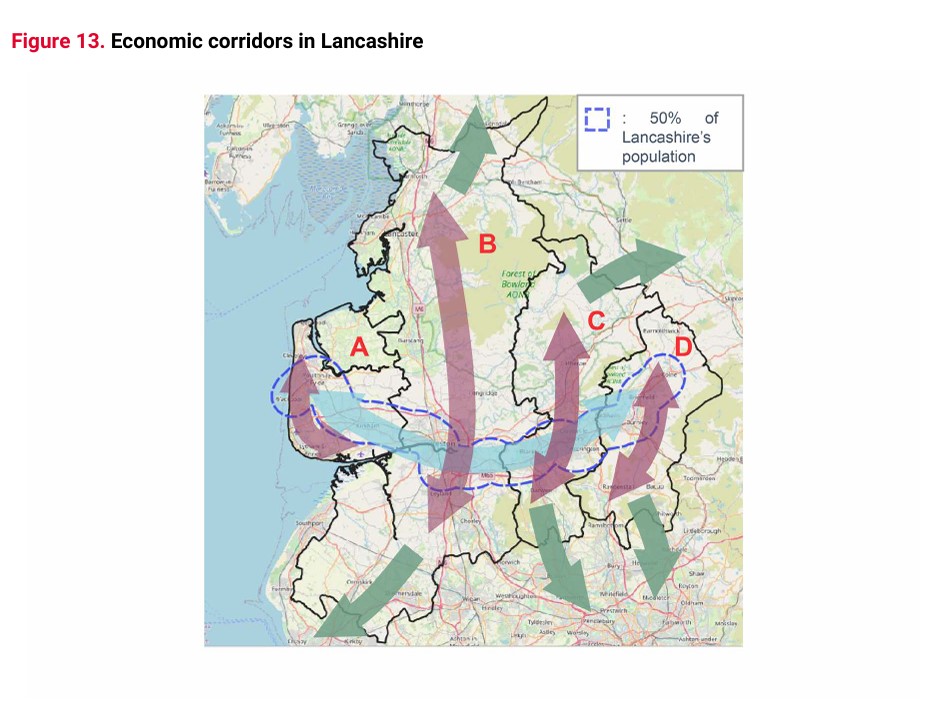
We would have preferred the first part of any Plan to have reflected these movement areas and to have looked at how to strengthen and improve the ability of citizens to move within them – ie. to build upon where we are actually moving around within Lancashire.
Making, as the Implementation Plan does, “East–West movements along the central belt” a “headline metric” suggests that planners don’t see things quite this way.
The second part, in our preference, would have been to address town centre issues in the urban cores of these corridors, including town centre parking, The third part would have been to strengthen access to “beacon” sites that have a capacity to draw in people from a wider area than just the corridor they sit in – such as Salmesbury BAe and Enterprise Zone. The fourth part would have been how to improve connections in general between the core areas. The fifth part would have been support for rural areas and the patterns of connection between these and their supporting urban areas. And the sixth part would have been the way the county as a whole connects to the outside world, and domestic and global markets.
The Plan divides up different schemes according to whether they are “early delivery”, in “development”, or just being assessed for feasibility – but it does not really aggregate these in to separate groups so that the reader can easily compare how much is actually in the pipeline as opposed to just being thought about. But they key thing for us is that it seems to be quite far away from what we would see as the “big ticket”, strategic infrastructure changes – namely:
a) A direct rail connection between Liverpool and Blackburn
b) Colne-Skipton rail line reconnection
c) Encouragement of an East Lancashire trans-Pennine rail freight connection, supported by a new rail freight terminal (at Hapton?)
d) Regular rail services extending the Ribble Valley rail service to Hellifield, thus opening a rail route between East Lancashire and Lancaster and Morecambe
e) Improving the trans-Pennine road connection from the M65
f) A single, publicly owned bus/tram/rail network covering all of Lancashire, alongside a ticketing system like the London Transport “oyster card”, which would allow people to move between public transport types as part of one journey
g) Free or cheaper town centre parking to support town centre economies, and free parking at NHS hospitals. Free parking areas linked to retail sites like Nova Scotia, in Blackburn, to be open to public use.
Car parking is one area where we are not so much aligned with the authorities. We are beginning to fear that it may be too late to save our town centres, but our position is that the only feasible way forward for them is to see the provision of town centre employment opportunities as a crucial element, and that this means having worker-friendly car parking. Parking can also support leisure and cultural activities, the two other mainstays of lively town centres. We are consequently disappointed to see the absence of schemes to support citizens through an improved parking offer. In fact, the comment made on p.58 of the Implementation Plan, that “The over-provision of parking contributes to a higher level of car dependency and reduces the uptake of sustainable transport. This is a particular issue in our town and city centres, where the potential is greatest for walking, wheeling and cycling”, appears to represent an aggressively opposite point of view.