Delegates at October’s Trades Council meeting received reports that illustrated a variety of the ways in which the dynamics of employment can provoke circumstances in which workers need to combine to take action to defend their interests.
European intentions to increase defence spending don’t appear to have fed through to the industry’s shop floor. BAE Systems recently announced a “job reduction” exercise at its Glasgow shipyards, with 116 management posts being lost, despite the £10bn deal with Norway in August to build the Nordic nation five Type 26 frigates.
There have been strike ballots over the summer at both Airbus and Collins Aerospace, leading to improved pay offers, and now 5,000 UNITE members at BAE Systems Warton and Samlesbury are balloting for strike action over a below RPI inflation 3.6% pay offer. You might call this a straightforward cost of living dispute. RPI Inflation was running at 4.6% in the latest August figure. The ballot will close on October 22nd, and action might commence from 5th November onwards
The National Education Union (NEU) is currently in dispute with its own staff, who are represented by UNITE, over a significant officer restructure plan. The members here are taking undertaken strike action to protest against the union’s management, citing concerns about inadequate consultation, potential workload increases, role downgrades, fixed-term contracts, and a general mishandling of the restructure plans.
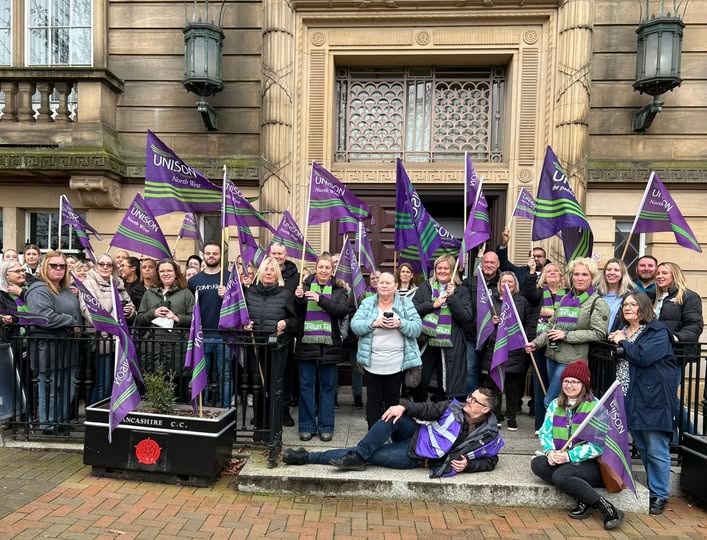
The long-running dispute involving Lancashire County Council Social Care Support Officers is a “give them an inch and they take a yard” situation. What begins with staff being flexible and wanting to support the work of their Department ends with them habitually being given responsibilities that should be restricted to higher paid colleagues, as a way of getting service delivery on the cheap and making up for structural recruitment problems. The SCSO role involves carrying out assessments and arranging and reviewing care packages for adults in the county. According to their union, UNISON, caseloads have grown more complex in response to social worker shortages, requiring them to support survivors of domestic abuse, victims of sexual exploitation and people going through periods of serious self-neglect. They are being expected to carry out duties that used to be reserved for social workers, who are paid significantly more than them. The members are taking intermittent periods of strike action, the next being on 14th and 16th October, with pickets outside County Hall, Preston from 8am to 10am.
Delegates had been pleased to hear that there had been a settlement in the dispute affecting local NHS domestics outsourced to MITIE. It was agreed to respond to a UNISON request and write to the North West Ambulance Service to support the cause of the ambulance educator staff who were currently in dispute following a management decision to unilaterally withdraw a Recruitment and Retention Premium, contrary to the guidance in the NHS national pay framework. The Trades Council has also written to our four local MPs on the question of the Birmingham Bin Workers’ dispute. Whilst this is clearly not a local matter it has now become a question of concern for the whole Labour Movement – and the issues raised around Equality legislation have a potentially widespread application. We have told our MPs:
“In our view, the way the Authority has invoked hypothetical Equality Act implications betrays an unacceptable approach to this legislation. The idea of complying with it by cutting, rather than raising, wages is simply a way of trying to evade its purpose, whilst blaming “the law” for what is, at root, a problem of low pay. There should be no levelling down of other workers’ wages to deliver bargain basement solutions. If equal pay means levelling down, not levelling up, then the working class is losing, not winning”.
Social matters considered by the meeting included an update on the Trades Council’s efforts to ensure that the NHS Integrated Care Board commits to holding a meaningful public consultation should it decide to press forward with a plan to move vascular in-patient services from Royal Blackburn Hospital to Preston. Correspondence from the ICB confirmed that “no decision has been made”, but the matter remained under active consideration and came across in meeting reports as a direction of travel to which NHS management was committed. We have been advised that nothing will happen until the matter has been run before the appropriate Local Authority Committees, and the ICB will then decide whether public consultation is required. This is still not entirely in line with the Guidance in “Planning, assuring and delivering service change for patients”, which says “in general, where there is commissioner led consultation with the local authority on a substantial service change, full public consultation will also be required”. We will need to remind the ICB of this at every appropriate opportunity.
Responses were approved to two public consultations that have been recently run by the Government.
In responding to the “Green Paper” on the Future of the Post Office, the Trades Council has argued for the re-unification of the Post Office with Royal Mail in the form of a re-nationalised public service. Since the break-up of the Postal Service in 2012, some 7,700 Post Office branches have been integrated into a retail business, but the Green Paper itself say that “Nearly half of all Post Office branches are not profitable for the postmasters running them or only make the postmaster a small profit from the Post Office part of the business”. The Post Office itself says that some 3,200 Post Offices are not commercially viable and require direct support.
The policy of successive governments has been to try and square the circle of Post Office viability by turning to widespread “franchising”, and the present government refers to what money it does contribute by means of subsidies as “unsustainable”.
Government’s direct contribution has dropped from a peak of £415 million in 2013-14 to £50 million in 2020-21 and the “Network Subsidy” will be £83m for 2025-26. Rather than “unsustainable” this comes across to us plainly as a cut to public spending.
“Franchising” ignores the responsibilities of the state whilst failing to consider what happens when commercial pressures collide with the general position of the “franchisees”. The potential detriment is that an appreciation of the Post Office’s social value is lost – and there is a consequential public perception that this is yet another public service becoming threadbare. It is a sure road towards the disappointment of public expectations.
The recent “Citizens Advice” report “The Full Package” observed: “Between 2012 and 2024, we’ve seen a substantial decline in full-time permanent branches (>1,400) and a significant increase in part-time outreaches (>800). Our previous research showed the significant impact this has had on consumers who rely most on the network to access services. These trends are due to post office operators finding it more difficult to run branches in a difficult economic environment, changing consumer habits, and competition”.
We don’t have any confidence that there can be a way of rebuilding this public service other than one based on the re-integration of our Postal Service, and an acceptance that this will need both investment of public funds to achieve the desired standards, and a review of the conditions under which the Service is obliged to deliver bulk mail distributed by other postal operators
In responding to the consultation on the “Smart metering policy framework post 2025” the Trades Council highlighted how potential estimates of household savings, on the one hand, were subject to question and how, on the other hand, how the rollout so far was bedevilled with technical difficulties.
In August 2022, a survey of 1,580 adults for Smart Energy GB found 37% of respondents with smart meters claimed to have had an issue with their meter at some point following its installation. When consumer campaigner Martin Lewis wrote to the Secretary Of State for Energy and Net Zero in September 2024 he said: “The Government’s estimate of how many domestic smart meters are not working is around 10%. Yet this only includes the narrow definition of smart meters in ‘dumb’ mode (ie, not sending automatic readings to the supplier). Our latest MSE research (via statistically representative polling), which asked people if their smart meters work, shows 19% say theirs don’t work. The reason this is so much higher is that it includes everything people feel has gone wrong, including in home displays that won’t communicate or connect, incorrect data on tariffs or usage, and prepay top-ups that don’t register correctly. These aren’t in the official stats”.
The energy consumption dilemma for too many British households is not focused on what an in-home display might say, but on the consequences of fuel poverty and poor standard housing. We have too many homes in too bad a state of repair. The campaign “Warm This Winter” claims that “new figures reveal that 16% of UK adults (8.8m people) live in cold damp homes, exposed to the health complications that come from living in fuel poverty”, whilst The Centre for Ageing Better has estimated that 2.6m owner-occupied households can be classed as “non-decent”, and 1.1m in the private rented sector
We consequently argued that the priority now should be: “To get what has already been done working properly, whilst there is an assessment of the value of continuing to proselytise adoption……..We think that smart meters should continue to be available to customers who want them, but that attempts to “push” them should now be curtailed. Any funding released from active campaigning should be directed towards reducing energy bills”
Delegates also received a progress update on planning for our meeting on “Young Workers and Trade Unions” – https://www.eventbrite.com/e/young-workers-and-trade-unions-a-discussion-meeting-in-blackburn-library-tickets-1636165598349?aff=oddtdtcreator – and a report from the “Transform not Reform” conference held in Preston in September.
The latter had produced a number of “demands” it was hoped that the Lancashire Association and Trades Councils would raise with local politicians going forward:
1. End the cost of living crisis – for a wealth tax and price controls on essential goods;
2. End privatisation and cuts;
3. For more and better welfare, against warfare;
4. Opposition to all forms of oppression; including racism, sexism, homophobia, disablism and transphobia;
5. Action on the climate crisis;
6. Repeal anti-union laws, for freedom of speech and freedom of organisation and assembly;
7. End the housing crisis, for a council house building programme;
8. For real investment in education, health and social care services.