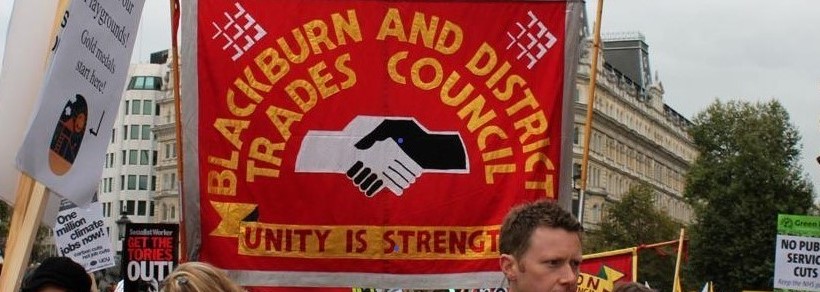
For a reason now obscured by late nineteenth century smog the Trades Council’s “year” runs like a “finacial year” – from April to March.
The early months of the calendar year are consequently the last months of our operational year, when a lot of our time is taken up with encouraging local Trade Union Branches to affiliate, or renew their affiliations.
This year it has also been a busy time for us in our work of making representations in response to several policy consultations.
At our January meeting we agreed a response to the consultations organised by the Government in relation to “Leave for bereavement including pregnancy loss” – a matter relating to implementation of a part of the Employment Rights Bill.
At our February meeting we concluded our discussions on the “Proposals for local government reorganisation in Lancashire, Blackburn with Darwen and Blackpool”, and agreed a paper in response to these. We approached this without a great deal of enthusiasm, because we saw it as representing a policy for which there was very little local demand and which is perceived as a top-down project by a Government that should be concentrating on other things. We are not entirely sold on the “bigger is better” line that is driving change in Local Government and which seems to be creating ever more remote and centralised entities – bigger Councils run by Executives or Mayors.
Presented, however, with the reality that some form of change seemed inevitable, and worried by some of the options being put forward, we thought we ought to contribute – commenting that from our point of view two things were of central importance: “The first is that there is a degree of singularity and separateness about East Lancashire. The second is that it would be unacceptable to define this without including the Ribble Valley”.
The evidence we gave for this included both a look at the historical background and information relating to modern “Trave to Work” patterns, with an aside about the East Lancashire “Island of Rhoticity” thrown in for good measure. You can have a look at our submission here:
Also at our February meeting we agreed a response to “Britain’s Story: The Next Chapter -the BBC Royal Charter Review, Green Paper”. This was a bit of a pain in the neck, since the Government was inviting responses through the form of a survey, which we thought really did not allow us to get over the points we wanted to make.
The important issue for us is that for a long time now the BBC has been at the centre of a battle over how much control over our media significant commercial interests, who would pump out content like the worst of American TV, can secure. The underlying reality is that the BBC’s competitors have long complained that the it is using its dominant position in the British media landscape to strangle opposition, both in traditional broadcasting and in the digital space. As Julian Petley commented in 2015 – “How the Murdoch press has waged a relentless campaign against the BBC (and why it’s worked)”: “Ever since Rupert Murdoch decided to enter the television game in the early 1980s, his newspapers have waged continuous war on public service broadcasters, and on the BBC in particular. These he sees purely as rivals in the broadcasting marketplace, and when Murdoch spots rivals his instinct is to exterminate them …”.
The problem we face now is that the previous Government deliberately eroded the “independence” the Licence Fee was supposed to give the BBC by using it as an instrument of correction, at the same time as there is a growing public inclination to see it as just one amongst many “subscriptions” – leading to a “why should I pay it if I don’t watch the programmes?” attitude. For us, the consequence that flows from having an “independent” public broadcaster is that it should have a dependable funding regime that is not based on use and is as protected as it can be from a need to attract either advertisers or government approval.
We therefore thought it was important to position our response as representing both how we saw the BBC in terms of the “impartiality” debate, alongside putting the argument in support of a free-to-air public broadcaster in the context of the efforts being made to undermine it. You can read our response here:
One matter that we looked at in March was a Government consultation looking at how the ban on “fire and rehire” might be implemented so as to allow employers to legally deploy “fire and re-hire” to impose changes in conditions such as benefits, expenses and shift patterns, even where the employees affected might be able to advance a strong case that these were agreed as parts of their contracts of employment. Delegates were particularly aware of the importance of working patterns to worker wellbeing and job satisfaction, and there were concerns that if some arrangements were excluded from being regarded as “restricted variations” it would significantly impact workers’ ability to defend their own interests. The way the Employment Act was eventually agreed means that “a variation of the timing or duration of a shift” only becomes a “restricted variation” where determined to be so by the Secretary of State – so we have urged the Government to come up with regulations that will give us stronger protection, beyond and in addition to what has been suggested.
At our April AGM we heard from the CWU about the situation at BT in Blackburn and Accrington, which we hope to report on more fully in a separate post next week. There were no changes to our Officers, and we began the process of discussing whether we might “host” some events in the coming year.
An “Annual Report” was presented by our Secretary, which concentrated on the question of the “cost of living” and various ancillary matters affecting the economic conditions of British workers. Its key message was that workers’ living standards had barely recovered from the 2008 Global Financial Crisis at the same time as there had been a boom time for the wealthiest. Wealth, however, was not generating growth, with Britain’s “productivity problem” and regional inequalities both being linked to low investment. If this was not bad enough, there were real prospects of a “war shock”, following on from the Israeli-American assault on Iran and Lebanon, and/or a “burst bubble” shock, should current levels of speculation in American AI stocks prove unsustainable.
You can download a copy here: