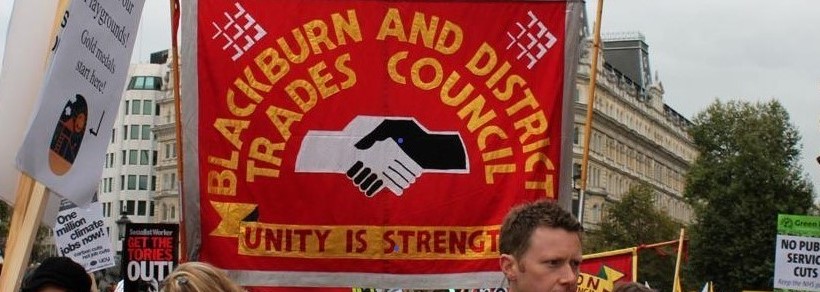
At its final meeting of 2025 Blackburn and District Trades Union Council agreed a response to the public consultation held by Lancashire County Council on the “In-House Provider Services Redesign” affecting some of its Adult Social Care services – in particular its Care Homes and Day Centres.
The immediate focus of attention is the proposal that 10 facilities for the elderly – 5 care Homes and 5 Day Centres – would close and that the services they provide would be “reprovisioned”.
The care homes under review are Favordale in Colne, Grove House in Adlington, Milbanke in Kirkham, Thornton House in Thornton Cleveleys and Woodlands in Clayton-le-Moors.
The day centres are Byron View in Colne, the Derby Centre in Ormskirk, Milbanke Day Centre in Kirkham, Teal Close in Thornton Cleveleys and Vale View in Lancaster.
It is clea from the Business Case published that that the current proposals are but the first stage in dismantling all in-house provider services, and that this will involve greater use of funds to support the commercial “market” – i.e. a solution in step with the “privatisation” of social care. The Business Case says that: “There is a marked shift in consumer preferences, with a growing reliance on the independent sector, which now accounts for over 80% of residential placements in the region”, as if our national policy of effectively “outsourcing” the social care sector for the elderly was not one of the egregious ills of our age.
Yes, there has been a shift to reliance on the private sector. In 2016 Bob Hudson, in an LSE Blog “The unsuccessful privatisation of social care: why it matters and how to curb it”, said: “In 1979, 64 per cent of residential and nursing home beds were still provided by local authorities or the NHS; by 2012 it was 6 per cent; in the case of domiciliary care, 95 per cent was directly provided by local authorities as late as 1993; by 2012 it was just 11 per cent. This shift to the private sector has also been accompanied by a growing role for large companies with 50+ homes at the expense of small, family-run businesses – five large chains alone now account for 20 per cent of provision and this figure is expected to rise”.
But we see this shift as being the consequence of political decisions, rather than an expression of public choice.
As Hudson put it then: “When private care homes are fending off financial problems, the quality of the care that they provide to residents has been found to diminish: the facilities deteriorate, staffing levels are reduced and additional ‘services’ for residents such as outings or entertainment, are cut back. In the case of domiciliary care there has been wholesale adoption of a flawed ‘task and time’ model with units of as little as 15 minutes per client imposed in order to reduce costs. And in perhaps the ultimate ‘commodification’ of care, some local authorities have put care packages for vulnerable people out to tender in eBay-style timed auctions. Unsurprisingly the most recent annual report by the regulator, the Care Quality Commission, found that 41 per cent of community-based adult social care services, hospice services and residential social care services inspected since October 2014 were rated as inadequate or requiring improvement” – and the same tale is told almost a decade later: “On average, for-profit care homes are worse quality and more selective than publicly-owned provision – and yet the for-profit sector has come to dominate the landscape in England’s social care”, says Benjamin Goodair from the Blavatnik School of Government’s Government Outcomes Lab, lead author of this recent article – Outsourcing adult social care has contributed to England’s care crisis, argue researchers | University of Oxford – which is based on research funded by the Nuffield Foundation.
It is our view that behind the rose-tinted spectacles view offered by the “Business Case”, the reality is one of a system where:
- There is evidence of a drop in care quality, with many private services receiving “inadequate” or “requires improvement” ratings.
- There is financial instability: The privatization model has led to the financial collapse of some large providers, highlighting the system’s vulnerability to market fluctuations. Financialization has led to profits being extracted from the sector, often through opaque corporate practices, with owners benefiting while service quality suffers.
- There are significant funding shortfalls, with some estimates suggesting a £3.5 billion gap in the sector.
- There are widespread staffing and pay issues: the profit-driven model can lead to cuts in staffing levels and low wages for care workers, which directly impacts the quality of care provided to residents.
- There is a two-tier system where many providers prioritize self-funding individuals, leaving those on public funds with limited options.
- There is an absence of true choice and control for service users and their families, as they often have a limited understanding of what life is like in a care home.
A recent report, “Ending extraction in the UK care system”, published by Reclaiming Our Regional Economies (RORE), has revealed how public money is being siphoned out of the care system rather than reinvested to improve services.
In 2024 alone, £3.8bn was spent by local authorities to fund care services in the North East, South Yorkshire and West Midlands combined authority regions. Yet not all of that investment reached those was designed to support.
Between 2021 and 2024:
- £256m of profit was made by companies providing care services in those regions
- Over a third of the companies involved were owned by private equity firms or companies based in tax havens (or both)
- £45m was paid out in dividends to shareholders
- £33.6m was paid in interest, up to 60% of which went straight to private equity and tax haven owned companies
Directors of the companies were earning up to 60 times more than the average wage, while frontline care workers were often paid below the living wage.
Both good and poor standards can be manifest in both in-house and independent provision, but there is a crisis of trust also in the ability of the Care Quality Commission to “hold the line” in either context: NHS and care regulator ‘not fit for purpose’ – BBC News.
The Council is essentially proposing to “liquidise” its fixed assets and to move more to sourcing replacements through the “market”. The fact, however, that the it can claim to identify “cashable financial benefits”, presumably based on the idea that buying-in services will be cheaper, merely highlights one of the acknowleged problems facing the sector. The concatenation of financial restraints, from government to local authorities and then from local authorities to care “providers”, is part of a picture where low payments made by local authorities to care providers are seen as a primary cause of several interconnected problems, including workforce instability, financial fragility for providers, disparities in care quality, and a growing amount of unmet need for care. Precicely because public funding effectively supports much of the system it is vulnerable to “behind the scenes” manipulation, with employers saying they can’t pay their staff enough because of what the local authority pays them, and the local authority saying it can only pay so much because of what it gets from the government. For the Council to be saying “we can get it cheaper” in this context is merely a reflection of how out of kilter the whole system has become.
In addition, the “Business case” specifically raises the possibility that the proceeds of liquidation might not end up being directed to any alternative provision at all: it cites “the need to deliver c.£50m of financial savings over the next two financial years”, as one of the reasons why there is a “need” for the Council“to review its in-house Provider Services over the next 12 to 18 months”. It does not give any guarantee as to how much, if any, of the estimated “£4.165m in annualised revenue savings” will be ring-fenced for reprovision – but once the in-house provision has been metamorphosed into cash its fate becomes less noticeable. Citizens notice the loss of assets, such as they are doing now. It is a lot harder to follow what is happening with more dispersed and generalised spending.
Ultimately, what we believe we need is the establishment of a National Care Service, with the independent sector either being nationalised or brought within a more co-ordinated and planned system – and so we are inclined to assess any specific proposals as to whether they trend towards, or away from, that end. What the County Council proposes seems clearly, to us, to be a step in the wrong direction.
The situation has provoked a strong public response and it has been reported that there have been more than 1600 responses to the consultation. The Council now says that it will take “extra time” to consider these and come to a conclusion.
Recommendations were originally expected to be brought before Councillors in February, but the process has now been left open ended.
According to “Lancs Live” on 19th December the ” Local Democracy Reporting Service” now says that the threatened facilities are again accepting admissions. The Council is quoted as saying: “Throughout the consultation, the affected homes continued to be used for short stays, and now the temporary pause on long-term admissions has been lifted. Any new residents and their families will be informed about the ongoing review, which we are taking additional time over.
“We will also continue to work closely with the NHS to make beds available to those in need. It is important to note that occupancy levels can fluctuate, but our focus remains steadfast on maintaining high-quality services and supporting residents to live their lives with dignity and care”.
UNISON North West have launched a petition “Hands off our Homes” – Hands off our homes – support Lancashire care workers fighting back! | Megaphone UK – in which they say: “UNISON have been informed by councillors that private firms have already been knocking at the door with various offers to buy the homes” and that “Workers have been told that there is no real consultation with them over the state of care work, and that they’ve been intimidated out of speaking to their union representatives. Staff have also been instructed not to speak to their own elected representatives about the issue”.
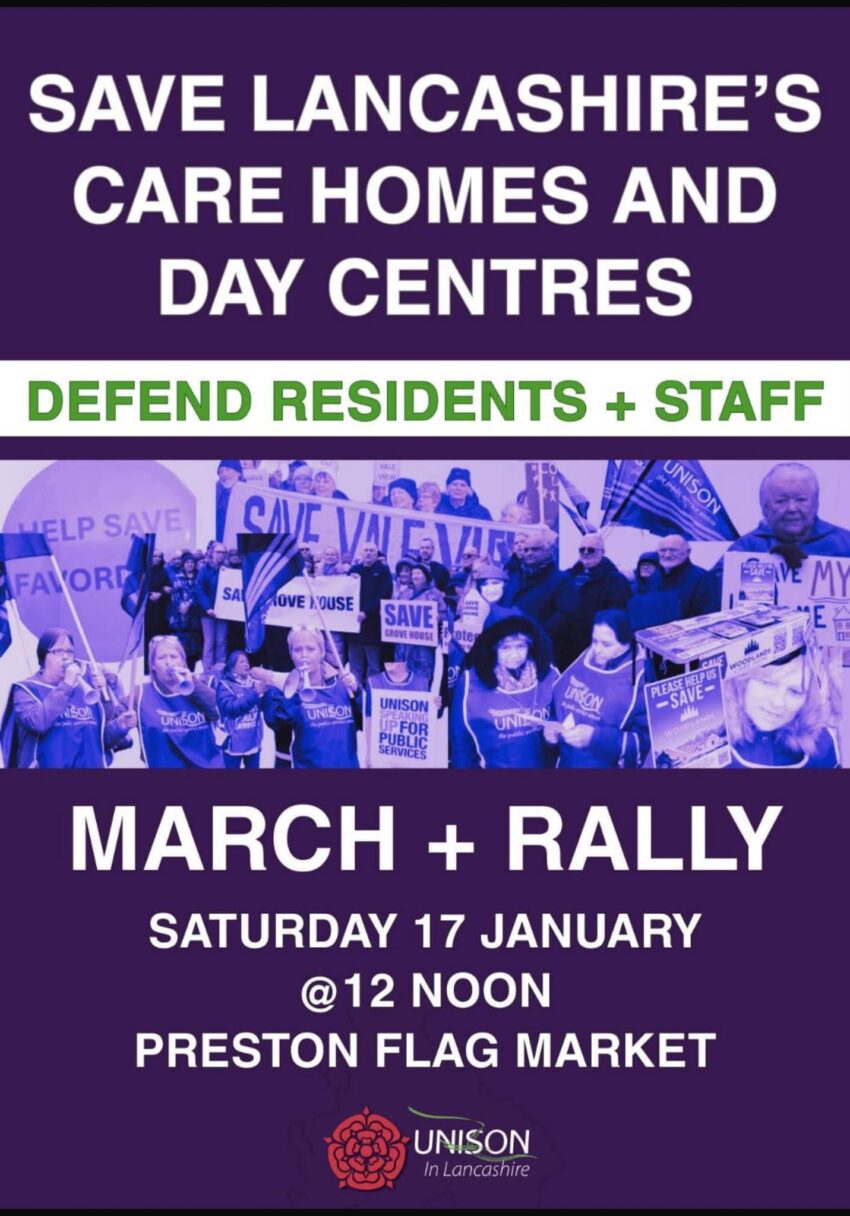
UNISON are also organising a March and Rally in Preston at 12 noon on Saturday 17th January, starting at the “Flag Market”.