
We must apologise for the delay in reporting here on how our 2025 Young Worker survey and meeting went.
A Report did go to our November Trades Council meeting, but we neglected to follow up here.
You may remember that we attempted to do two things. Firstly, to run a local survey. And, secondly, to hold a public meeting to discuss the results and, more broadly, how we could improve in encouraging young worker participation.
On both sides of the project, we encountered problems, which may in themselves suggest areas in which we need to get better.
The number of survey responses (16) was enormously disappointing. It may, in itself, be the clearest expression of a lack of interest, though we cannot be sure of the extent to which this explains the outcome as opposed to a failure to even get public attention. The big-bucks-backed media, of course, did not consider our efforts “newsworthy”, and “social media” has its own obstacles.
Probably of more impact is that we are ham-fisted with some types of social media, such as Tik-Tok and Instagram, whilst not being all that proficient at “cascading” across others, like Facebook – where anything put out can rapidly get lost amongst a torrent of transient urgencies. On top of that, there is some evidence that a proliferation of surveys may be leading to lower response rates everywhere.
Even had we secured a better response rate, we must accept that there are caveats about how representative an “unweighted”, self-selecting response can be. It may give a “flavour” of things, without being statistically robust.
The responses we did get came mainly from older young workers (62% between 25-35), who were mostly in full-time jobs (81%). So, our small sample was arguably not particularly typical. Even so, 75% of our respondents were still not union members, and 75% of those who were not members had not been members at any time before.
The three main reasons the respondents saw as “barriers” to Union Membership were: not having been asked to join, lack of knowledge, and feeling that Unions are not relevant:
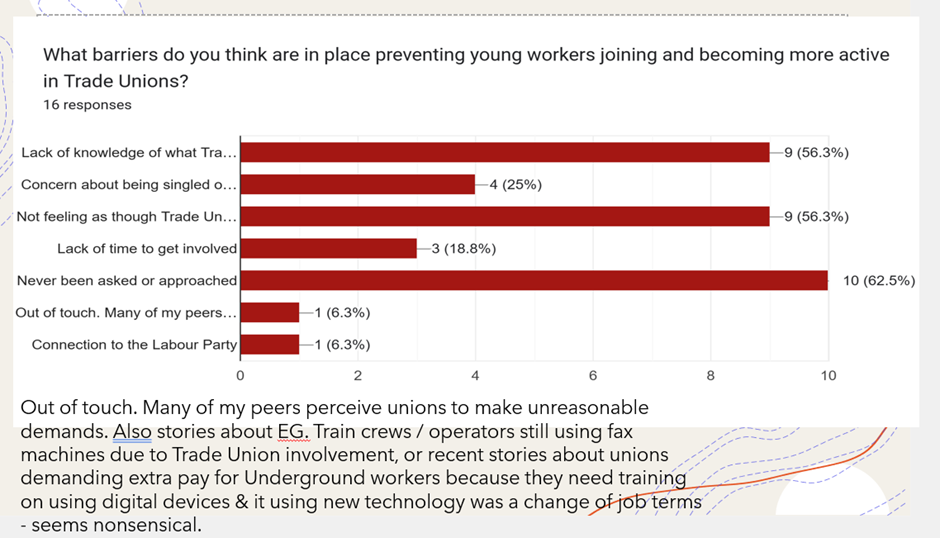
The comment about train crews and fax machines, by the way, shows how powerful urban myths can be. It relates to a specific story where the rail company involved eventually admitted that it had never in fact asked the staff to stop using the old technology.
“Fair treatment and respect” came out as the top thing that respondents would want to see a Union achieve in their own workplace:
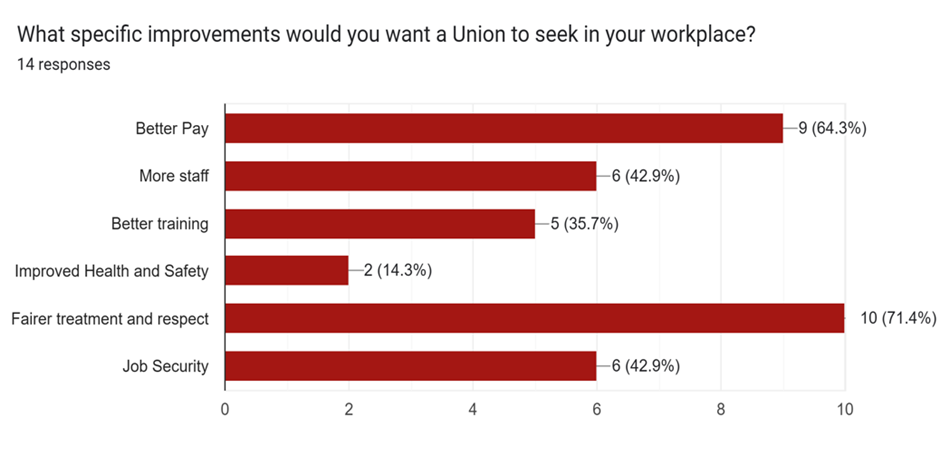
The added comments provided a reminder that outcomes are not always ideal: “I joined my first union to get support in a hearing about my contract ending and being let go. If I had kept my job I would have stuck with the union for as long as I was in that industry”.
In line with the survey response rate, interest in the public meeting did not run high – to the extent that we abandoned the plan of holding it in Blackburn Library and went wholly online instead.
We have had favourable feedback from those who were able to attend the meeting, where we listened to contributions from Fraser McGuire and from Zaihera Chaudhry, who is the Chair of UNISON’s North West Young Members Committee.
Fraser went over some of the general background material, noting that the information we had was that 19 out of every 20 workers between the ages of 18 and 24 were not union members, and that the majority of local, lay Trade Union officers and stewards were aged over 35 – with a high proportion edging towards retirement.
It was not the case, however, that Unions had not tried to turn the tide. It was more a case of us yet being able to find a consistent practice able to re-assert our position when faced with major changes in where jobs were available. Union membership had held up where places of employment had not been submerged by these changes, but the two great problems facing our movement – loss of density and generational erosion – were intimately linked.
Young people were not apathetic or unwilling to stand up for themselves or others. Movements like the campaigns around Palestine or climate change had plenty of young workers in their ranks. And there were examples, in his own sector of hospitality, for instance, where they clearly showed themselves more than capable of grasping the nettle. But there was still something very hit and miss about workplace grievances and union organisation coming together.
It did not help, of course, that major employers were actively resolved to resist unionisation – and this was itself not unconnected with their deployment of precarity and indifference to staff churn.
Contact and relevance remained the key areas, but in a world that was superficially criss-crossed with a network of communications it had become a feature that people often no longer moved in wide social circles, such as workplaces with a multi-generational workforce used to provide. We had, therefore, to be on the lookout for opportunities to get round this – and social media alone was not a magic bullet. Techniques deserving examination included workplace visits and developing links with education establishment, through things like a presence at Freshers Fairs.
Zahaira spoke more about her own journey towards becoming a Trade union activist and reflected on what lessons she could draw from this. Even as a Politics student she had been told very little about what Unions did, and she was quite possibly only recruited in the first place because her Branch had run a sort of “recruit a colleague” reward scheme.
She felt that Branches should try to be aware of the sort of invisible gateways to participation that they could have established without even being aware of it. It was not enough, for instance, to feel “job done” because you had managed to fill the key local officer jobs – difficult as even that could be. Branches could lose the habit of seeing themselves as entities requiring collective endeavour and responsibility.
Providing opportunities for involvement was just as important as recruitment, and that could involve taking more care to explain to new and young members in particular “how things worked”. Even at Branch level, local leaders could presume that people automatically knew what some of the basic terms meant – the AGM, the Branch Executive, procedures, and so on.
Branches should give thought as to how to identify signs of interest, and then on how to mentor and support young activists. It was not enough just to send them off on a course – they should have the opportunity of a particular person of experience to call on for guidance and support whenever they felt they needed it.
Most Unions had by now also developed “young member” structures and committee, but it was a responsibility of Branches to make sure that members were aware of these and supported in engaging with them. Effective communication at Branch level was one of the fundamentals.
Both of our speakers encouraged us to give the survey idea another go, as they felt it could develop if it was more than a one off.
Fraser said that he was also currently working with the TUCJCC (the national TUC committee which oversees Trades Councils and is made up of regional reps elected by the Trades Councils and representatives of the TUC’s General Council) to provide a Guide on young workers for Trades Councils. (A cursory glance at any gathering of Trades Council officers is as good an image of the “generational cliff” as any you are likely to get).